
Menu
Why Being Model Agnostic Is Critical for Your Business Strategy
Published on November 10, 2025
Why Being Model Agnostic Is Critical for Your Business Strategy
The AI landscape is moving incredibly fast. New models drop every few months, pricing changes can happen overnight, and performance benchmarks keep shifting. In an environment like this, building your entire infrastructure around a single AI provider isn’t really a strategy—it’s a risk.
That’s why model-agnostic architecture is becoming a key principle for organizations that want to stay flexible and competitive.
Avoiding Vendor Lock-in in a Volatile Market
Relying on one AI vendor—whether it’s OpenAI, Anthropic, Google, or anyone else—can create a serious dependency called vendor lock-in.
Vendor lock-in makes it harder to:
- React to unexpected price increases
- Switch to better-performing models
- Meet regional or regulatory requirements
- Control latency and choose where you deploy
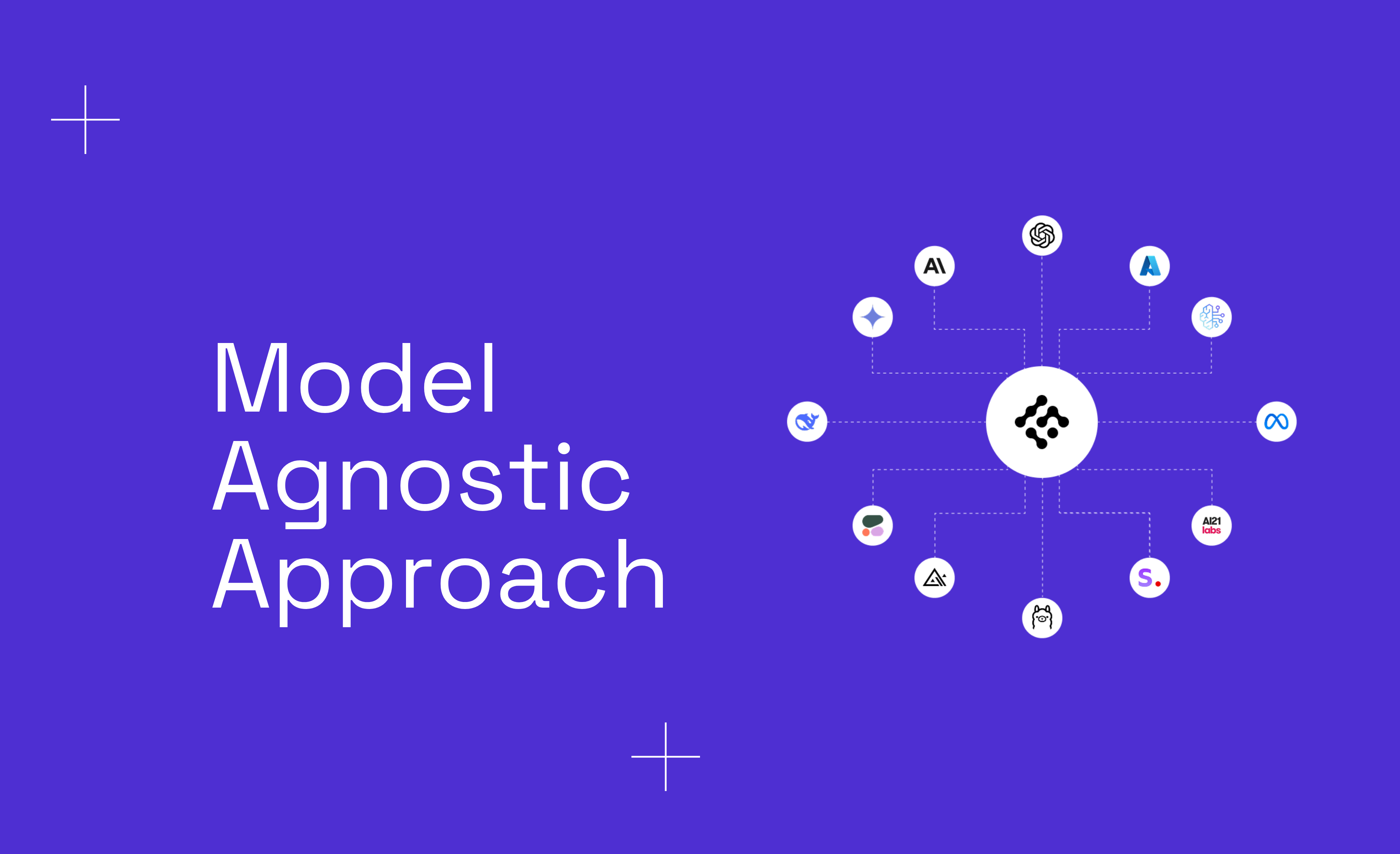
A model-agnostic approach helps remove these limits. It gives businesses the freedom to switch models, mix them, or replace them over time as both the market and internal needs evolve.
Cost Optimization Through Smart Model Selection
Not every task needs a huge, expensive model.
With a model-agnostic setup, organizations can:
- Use smaller, faster models for routine classification and extraction
- Deploy mid-sized models for customer-facing interactions
- Save top-tier reasoning models for complex analysis and decision-making
For example, one workflow might use Gemini for analytical tasks, Llama for low-latency operations, and a frontier model for deeper reasoning. Choosing the right model for the right job can significantly reduce costs without sacrificing quality.
Future-Proofing Your AI Stack
One of the biggest advantages of being model agnostic is future-proofing.
No one can say for sure which model will lead next year—or even next quarter. Open-source breakthroughs, new architectures, and changing regulations will keep reshaping the ecosystem.
A flexible AI foundation ensures that:
- Your systems can adopt next-generation models quickly
- Integrations don’t require major rewrites
- Innovation is driven by your strategy, not vendor limitations
Instead of rebuilding your stack every time the market changes, you simply plug in what works best next.
Strategic Flexibility Is a Competitive Advantage
AI is no longer just an experiment—it’s becoming a core business capability. Companies that lock themselves into rigid, single-vendor solutions risk falling behind teams that move faster and adapt quicker.
At AIME, our platform is built around this mindset. We don’t force businesses into fixed boxes. We provide a flexible framework that connects your data, workflows, and agents with any model—today or in the future.
That way, your AI strategy stays adaptable, cost-efficient, and competitive in an industry where change is constant.